
Anatomy
The aegov-blockquote component renders a single native <blockquote> element. The primary (default) appearance shows a decorative quotation-mark icon; the colored appearance replaces it with a tinted background and a colored start-edge border instead. An optional footer holds the author and authorTitle, shown only when at least one is set.
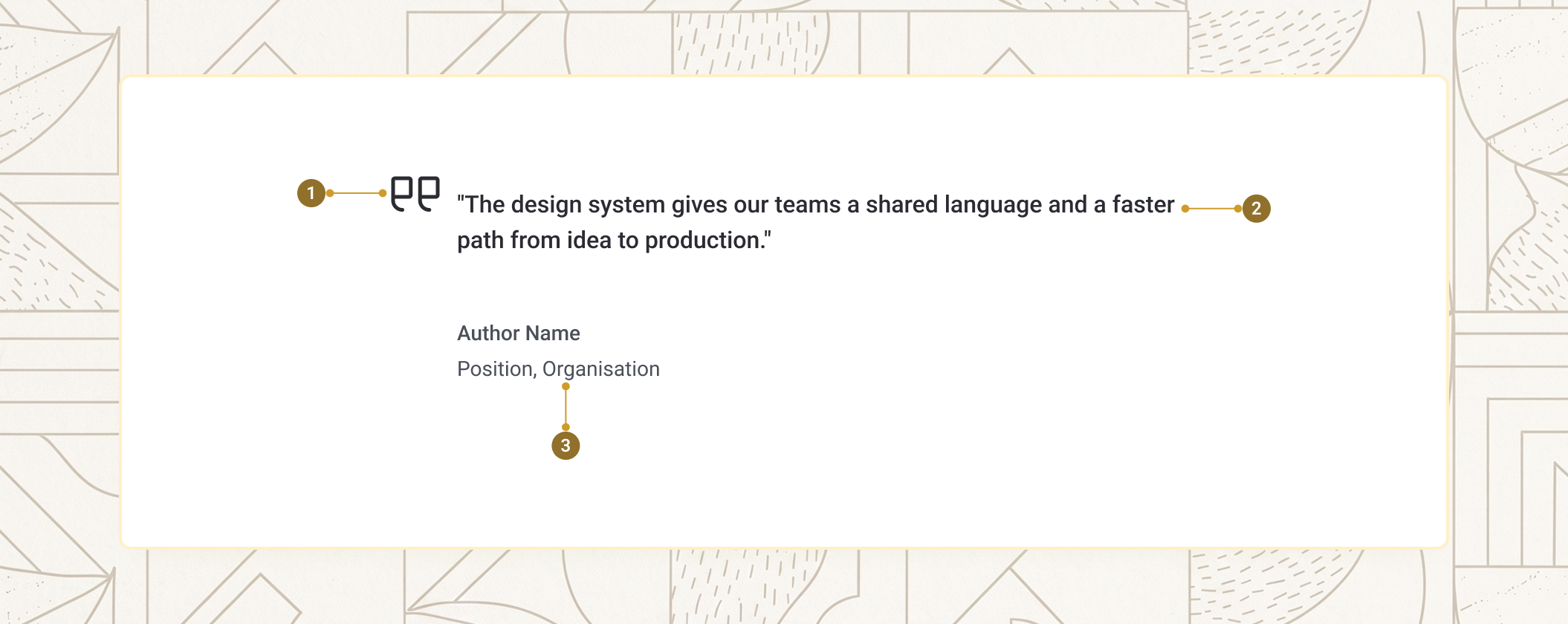
| Item | Name | Description |
|---|---|---|
1 |
Quotation mark (primary only) | A decorative SVG icon, hidden entirely in the colored appearance |
2 |
Quote content | The slotted quotation text |
3 |
Footer (optional) | Shows author and/or authorTitle; only rendered when at least one is set |
Options
Appearance
primary (default) shows the decorative quotation mark. colored replaces the icon with a tinted background panel and a colored start-edge border.
primary (default)
colored
<aegov-blockquote appearance="primary">…</aegov-blockquote>
<aegov-blockquote appearance="colored">…</aegov-blockquote>import { AegovBlockquote } from '@aegov/designsystem-react';
export default function BlockquoteAppearance() {
return (
<>
<AegovBlockquote appearance="primary">…</AegovBlockquote>
<AegovBlockquote appearance="colored">…</AegovBlockquote>
</>
);
}<template>
<aegov-blockquote appearance="primary">…</aegov-blockquote>
<aegov-blockquote appearance="colored">…</aegov-blockquote>
</template>import { Component } from '@angular/core';
import { AegovBlockquote } from '@aegov/designsystem-angular';
@Component({
selector: 'app-blockquote-appearance',
imports: [AegovBlockquote],
template: `
<aegov-blockquote appearance="primary">…</aegov-blockquote>
<aegov-blockquote appearance="colored">…</aegov-blockquote>
`,
})
export class BlockquoteAppearanceComponent {}Attribution
author names the person or source; authorTitle gives their role. Both are optional, but a quote with no attribution rarely carries weight in a government context.
Author and title
Provide author alone, author with authorTitle, or neither — the footer is only rendered when at least one of them is set, so an unattributed quote renders with no empty footer space.
<!-- Full attribution -->
<aegov-blockquote author="Ahmed Al Mansouri" author-title="Director of Digital Services">…</aegov-blockquote>

<!-- Author only -->
<aegov-blockquote author="Ahmed Al Mansouri">…</aegov-blockquote>

<!-- No attribution -->
<aegov-blockquote>…</aegov-blockquote>import { AegovBlockquote } from '@aegov/designsystem-react';
export default function BlockquoteAttribution() {
return (
<>
{/* Full attribution */}
<AegovBlockquote author="Ahmed Al Mansouri" authorTitle="Director of Digital Services">…</AegovBlockquote>
{/* Author only */}
<AegovBlockquote author="Ahmed Al Mansouri">…</AegovBlockquote>
{/* No attribution */}
<AegovBlockquote>…</AegovBlockquote>
</>
);
}<template>
<!-- Full attribution -->
<aegov-blockquote author="Ahmed Al Mansouri" author-title="Director of Digital Services">…</aegov-blockquote>
<!-- Author only -->
<aegov-blockquote author="Ahmed Al Mansouri">…</aegov-blockquote>
<!-- No attribution -->
<aegov-blockquote>…</aegov-blockquote>
</template>import { Component } from '@angular/core';
import { AegovBlockquote } from '@aegov/designsystem-angular';
@Component({
selector: 'app-blockquote-attribution',
imports: [AegovBlockquote],
template: `
<!-- Full attribution -->
<aegov-blockquote author="Ahmed Al Mansouri" author-title="Director of Digital Services">…</aegov-blockquote>
<!-- Author only -->
<aegov-blockquote author="Ahmed Al Mansouri">…</aegov-blockquote>
<!-- No attribution -->
<aegov-blockquote>…</aegov-blockquote>
`,
})
export class BlockquoteAttributionComponent {}Citing a source
cite takes the URL of the source and maps to the native cite attribute on the <blockquote> element. It is not visible — browsers do not render it, so it is machine-readable metadata only.
<aegov-blockquote
  cite="https://u.ae/en/about-the-uae/digital-uae"
  author="UAE Digital Government Strategy"
  author-title="2025–2030"
>
  All federal services will be delivered digitally by default, with in-person channels
  retained for those who need them.
</aegov-blockquote>import { AegovBlockquote } from '@aegov/designsystem-react';
export default function BlockquoteCitation() {
return (
<AegovBlockquote
cite="https://u.ae/en/about-the-uae/digital-uae"
author="UAE Digital Government Strategy"
authorTitle="2025–2030"
>
All federal services will be delivered digitally by default, with in-person channels
retained for those who need them.
</AegovBlockquote>
);
}<template>
<aegov-blockquote
cite="https://u.ae/en/about-the-uae/digital-uae"
author="UAE Digital Government Strategy"
author-title="2025–2030"
>
All federal services will be delivered digitally by default, with in-person channels
retained for those who need them.
</aegov-blockquote>
</template>import { Component } from '@angular/core';
import { AegovBlockquote } from '@aegov/designsystem-angular';
@Component({
selector: 'app-blockquote-citation',
imports: [AegovBlockquote],
template: `
<aegov-blockquote
cite="https://u.ae/en/about-the-uae/digital-uae"
author="UAE Digital Government Strategy"
author-title="2025–2030"
>
All federal services will be delivered digitally by default, with in-person channels
retained for those who need them.
</aegov-blockquote>
`,
})
export class BlockquoteCitationComponent {}If readers should be able to reach the cited source, add a visible link after the quote — cite alone is never enough, since it is invisible to sighted users.
Extra classes
extraClass only applies margin/padding (spacing) utilities to the rendered <blockquote> element — e.g. mt-10. Width, colour, and every other visual utility have no effect (see the note above). To constrain reading width, put a width class on the host (class="max-w-3xl") or wrap the component in your own element instead.
<div class="max-w-prose mx-auto">
  <aegov-blockquote extra-class="mt-10" author="…">…</aegov-blockquote>
</div>import { AegovBlockquote } from '@aegov/designsystem-react';
export default function BlockquoteExtraClass() {
return (
<div className="max-w-prose mx-auto">
<AegovBlockquote extraClass="mt-10" author="…">…</AegovBlockquote>
</div>
);
}<template>
<div class="max-w-prose mx-auto">
<aegov-blockquote extra-class="mt-10" author="…">…</aegov-blockquote>
</div>
</template>import { Component } from '@angular/core';
import { AegovBlockquote } from '@aegov/designsystem-angular';
@Component({
selector: 'app-blockquote-extra-class',
imports: [AegovBlockquote],
template: `
<div class="max-w-prose mx-auto">
<aegov-blockquote extra-class="mt-10" author="…">…</aegov-blockquote>
</div>
`,
})
export class BlockquoteExtraClassComponent {}RTL support
The blockquote is direction-aware — text and attribution follow the reading direction automatically, and the decorative quotation mark stays anchored to the inline-start corner in both directions, with its shape horizontally mirrored so it opens the correct way in Arabic rather than appearing reversed.
<div dir="rtl">
  <aegov-blockquote author="سعادة سارة الأميري" author-title="وزيرة دولة للتعليم العام">
    الحكومة الرقمية ليست عن التقنية، بل عن جعل الخدمات بسيطة إلى حدٍّ لا يحتاج معه الناس إلى التفكير فيها.
  </aegov-blockquote>
</div>import { AegovBlockquote } from '@aegov/designsystem-react';
export default function BlockquoteRtl() {
return (
<div dir="rtl">
<AegovBlockquote author="سعادة سارة الأميري" authorTitle="وزيرة دولة للتعليم العام">
الحكومة الرقمية ليست عن التقنية، بل عن جعل الخدمات بسيطة إلى حدٍّ لا يحتاج معه الناس إلى التفكير فيها.
</AegovBlockquote>
</div>
);
}<template>
<div dir="rtl">
<aegov-blockquote author="سعادة سارة الأميري" author-title="وزيرة دولة للتعليم العام">
الحكومة الرقمية ليست عن التقنية، بل عن جعل الخدمات بسيطة إلى حدٍّ لا يحتاج معه الناس إلى التفكير فيها.
</aegov-blockquote>
</div>
</template>import { Component } from '@angular/core';
import { AegovBlockquote } from '@aegov/designsystem-angular';
@Component({
selector: 'app-blockquote-rtl',
imports: [AegovBlockquote],
template: `
<div dir="rtl">
<aegov-blockquote author="سعادة سارة الأميري" author-title="وزيرة دولة للتعليم العام">
الحكومة الرقمية ليست عن التقنية، بل عن جعل الخدمات بسيطة إلى حدٍّ لا يحتاج معه الناس إلى التفكير فيها.
</aegov-blockquote>
</div>
`,
})
export class BlockquoteRtlComponent {}Mark a quote in a different language from the rest of the page with lang and dir on the host, so a screen reader switches voice correctly (WCAG 2.2 SC 3.1.2) — for example <aegov-blockquote lang="en" dir="ltr" author="…">An English quotation on an Arabic page.</aegov-blockquote>.
Common uses
A common use for a blockquote is a testimonial — pairing it with a card, often alongside others in a grid.
Testimonial cards
Pairing a blockquote with a card gives each testimonial a clear visual boundary — useful when showing several quotes together in a grid, as below.
What people said about the new service
<section>
  <h2 class="font-bold text-h4 mb-6">
    What people said about the new service
  </h2>

  <div class="grid gap-6 md:grid-cols-2">
    <aegov-card appearance="light" variant="neutral-min">
      <aegov-blockquote author="Fatima Al Suwaidi" author-title="Dubai">
        The service told me exactly what I needed before I started.
      </aegov-blockquote>
    </aegov-card>

    <aegov-card appearance="light" variant="neutral-min">
      <aegov-blockquote author="Omar Al Hashimi" author-title="Sharjah">
        I renewed my card from my phone in four minutes, in Arabic.
      </aegov-blockquote>
    </aegov-card>
  </div>
</section>import { AegovCard, AegovBlockquote } from '@aegov/designsystem-react';
export default function BlockquoteTestimonialCards() {
return (
<section>
<h2 className="font-bold text-h4 mb-6">
What people said about the new service
</h2>
<div className="grid gap-6 md:grid-cols-2">
<AegovCard appearance="light" variant="neutral-min">
<AegovBlockquote author="Fatima Al Suwaidi" authorTitle="Dubai">
The service told me exactly what I needed before I started.
</AegovBlockquote>
</AegovCard>
<AegovCard appearance="light" variant="neutral-min">
<AegovBlockquote author="Omar Al Hashimi" authorTitle="Sharjah">
I renewed my card from my phone in four minutes, in Arabic.
</AegovBlockquote>
</AegovCard>
</div>
</section>
);
}<template>
<section>
<h2 class="font-bold text-h4 mb-6">
What people said about the new service
</h2>
<div class="grid gap-6 md:grid-cols-2">
<aegov-card appearance="light" variant="neutral-min">
<aegov-blockquote author="Fatima Al Suwaidi" author-title="Dubai">
The service told me exactly what I needed before I started.
</aegov-blockquote>
</aegov-card>
<aegov-card appearance="light" variant="neutral-min">
<aegov-blockquote author="Omar Al Hashimi" author-title="Sharjah">
I renewed my card from my phone in four minutes, in Arabic.
</aegov-blockquote>
</aegov-card>
</div>
</section>
</template>import { Component } from '@angular/core';
import { AegovCard, AegovBlockquote } from '@aegov/designsystem-angular';
@Component({
selector: 'app-blockquote-testimonial-cards',
imports: [AegovCard, AegovBlockquote],
template: `
<section>
<h2 class="font-bold text-h4 mb-6">
What people said about the new service
</h2>
<div class="grid gap-6 md:grid-cols-2">
<aegov-card appearance="light" variant="neutral-min">
<aegov-blockquote author="Fatima Al Suwaidi" author-title="Dubai">
The service told me exactly what I needed before I started.
</aegov-blockquote>
</aegov-card>
<aegov-card appearance="light" variant="neutral-min">
<aegov-blockquote author="Omar Al Hashimi" author-title="Sharjah">
I renewed my card from my phone in four minutes, in Arabic.
</aegov-blockquote>
</aegov-card>
</div>
</section>
`,
})
export class BlockquoteTestimonialCardsComponent {}Usage
Here is the recommended usage of a blockquote on any website or application. These are recommended usage guides, however the developer must use the best practices of web and application development to accurately use this component.
Attribute the quote whenever practical
Set author (and authorTitle where the role adds weight). An unattributed quotation reads as an unsourced claim, especially in a government context.
Add a visible link when the source should be reachable
cite is machine-readable metadata only — it is never shown to sighted users. Pair it with a visible link after the quote if readers need to reach the source.
Keep quotations to a comfortable reading width
Roughly 60–100 characters per line, same as body copy. Put a width class on the host (for example class="max-w-3xl") if the surrounding layout does not already constrain it — extra-class only accepts spacing utilities.
Keep the quote itself short — one focused statement, not a passage
A blockquote is meant to highlight a single, punchy point, not carry an extended argument. If the source material runs long, quote the strongest sentence and summarise the rest in your own words outside the blockquote.
Do not use a blockquote for visual emphasis
It is semantic markup for quoted material, not a text-styling shortcut. To highlight your own words, use a Callout; to make text larger without implying a quotation, use Text with a size token.
Do not put interactive controls inside the quote
A link within quoted text is acceptable; a button is not. Buttons turn quoted content into a control surface, which is confusing for assistive technology.
API reference
The following are the properties and references of a blockquote
aegov-blockquote default properties
| Attribute | Description | Type | Default |
|---|---|---|---|
| The blockquote appearance style. |
|
|
| The citation source (a URL). Maps to the native |
|
|
| The author or source of the quote. |
|
|
| The author's title, role, or position. |
|
|
| Additional CSS classes merged onto the inner |
|
|
This component renders inside a real shadow DOM, so extra-class only applies margin/padding (spacing) utilities — e.g. mt-4, md:px-6. Colour, border, width, typography, and every other visual utility are silently ignored, keeping it visually consistent wherever it's used. The inner element is exposed as a CSS part, ::part(blockquote), for the rare case where a deliberate style override is genuinely needed.
Slots
| Slot | Description |
|---|---|
(default) | The quoted text to render inside the blockquote. |
Pass-through attributes
| Attribute | Notes | Forwards to |
|---|---|---|
| Forwarded automatically. | inner |
lang and dir are not forwarded by the component code above — there is no explicit pass-through for them. They still work when set on <aegov-blockquote> because both are inherited across the shadow boundary like any other HTML element (the same mechanism that lets a page-level dir="rtl" flip the reading direction and text alignment automatically). Set them directly on the host only when a single quote is in a different language from the rest of the page — otherwise the page's own lang/dir already applies.
Notes
The following notes are applicable of this component.
Built-in accessibility
- The rendered element is a real
<blockquote>, so the quotation is conveyed structurally, not only visually — screen readers can announce the boundaries of quoted content. citemaps to the nativeciteattribute, keeping the source machine-readable. It is not visible to sighted users; browsers do not render it.- The decorative quotation-mark icon is
aria-hidden="true", so it is never announced as content — its visual orientation (see the note under RTL support) has no bearing on accessibility either way. - Attribution (
author/authorTitle) renders inside the quote block in a fixed position, so it is never separated from the quotation it belongs to.
Developer responsibility
The following is required for a developer to add additionally or pay attention to regarding this component.
- Attribute your quotes where practical. Set
author(andauthorTitlewhere the role adds weight) — an unattributed quotation reads as an unsourced claim, especially in a government context. citeis invisible to sighted users. Add a visible link after the quote as well if the reader should be able to reach the source.- Keep quotations to a comfortable reading width, roughly 60–100 characters per line — a full-width pull quote is harder to read than the body copy around it. Put a width class on the host (for example
class="max-w-3xl") if the surrounding layout does not already constrain it —extra-classonly accepts spacing utilities, so width classes there have no effect. - Do not use a blockquote purely for visual emphasis. It is semantic markup for quoted material — to highlight your own text use a Callout, and to make text larger without implying a quotation use Text with a size token.
- Mark a quote that is in a different language from the rest of the page with
langanddiron the host, so assistive technology switches pronunciation correctly (WCAG 2.2 SC 3.1.2). - Check contrast when using
appearance="colored"— the tinted background sits behind the text, and the 4.5:1 minimum of WCAG 2.2 SC 1.4.3 still applies. - Restore contrast in dark mode yourself. Colours inside the shadow root are fixed light-mode colours and do not follow a page-level
.darkclass; override them with::part(blockquote)and style slotted<p>elements directly. The author and title lines cannot be restyled. - Avoid putting interactive content inside the quote. A link within quoted text is fine; a button is not — it turns quoted content into a control surface.
Additional notes
- Quote accuracy (using an ellipsis for omissions, etc.) is an editorial responsibility, not something the component enforces.