
The Disappearing Handoff: How AI is Collapsing the Gap Between Design and Code
A designer working for a federal entity opens her laptop on a Monday morning. The brief: a new digital service for residents to request a document attestation. Three years ago, this work would have unfolded over weeks with:
- a wireframing phase
- a high-fidelity design phase
- a long handoff document
- a developer interpretation phase
- a round of design QA
- after which, turned over to a development team to build
- after weeks of waiting, doing a design review.
... and only then, something a UAE resident or citizen could experience.
This Monday looks different.
By 11am she has a working bilingual prototype. UAE Pass is mocked in. The form respects the AEGOV Design System's typography and colour rules. By 2pm, a focus group of UAE residents are testing it on real mobile devices. By Wednesday, the second iteration is live for broader feedback.
AI hasn't made her a better designer. It has compressed every step between her thinking and a citizen or resident using something. The handoff has, for practical purposes, disappeared.
The translation step is dissolving
For most of the last two decades, building a government digital service has involved a technical translation step. Designers worked in design tools. Developers worked in code. A document, a Figma file, or a long Slack thread sat between them. This is the handoff.
That handoff has carried more weight than we admit. It is where ambiguity creeps in. It is where the design system gets misinterpreted. It is where typography falls back to defaults. It is where weeks disappear into discussions about common ground.
What AI design tools are doing — quietly, across several categories — is dissolving that step.
The most useful way to describe what is happening is not "AI is generating UI". It is this: design and code are merging into a single continuous conversation. The design system becomes an input to that conversation. And, if we get it right, the people of the UAE join the conversation earlier than ever before.
This is the shift worth paying attention to.
Four categories of capability
Product names will change. Capabilities tend to compound. It helps to think in four categories rather than to track a tool roster.
1. Generative UI
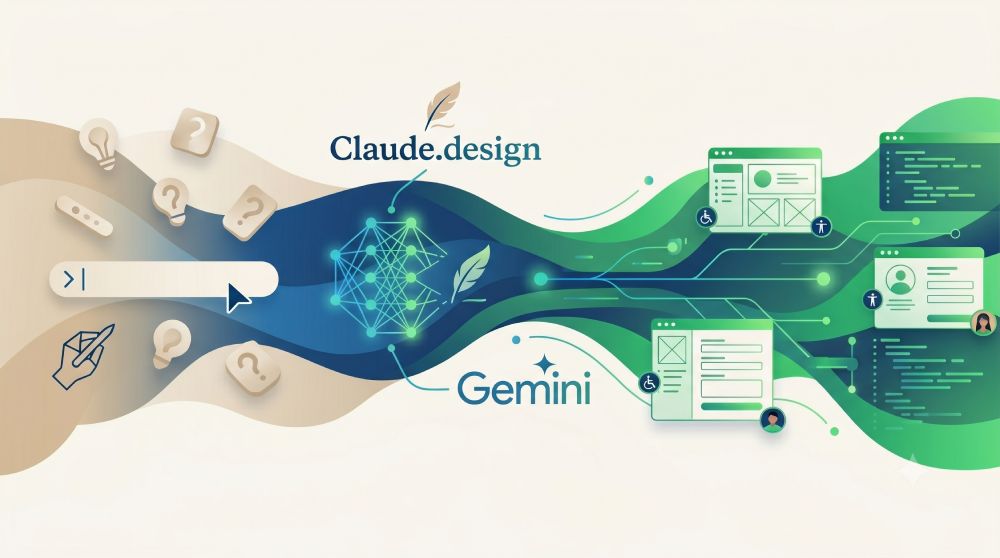
These tools take a description in plain language, sometimes paired with a sketch or screenshot — and return working, semantic markup. Claude.design is a clean example: you provide it with a design system, you describe the screen you need, and you get a working interface back, often with sensible accessibility defaults.
For government work, the strongest use case is the first draft. The technical translation step from "what we heard" to "what we can test" has nearly vanished. You now have a basic starting point to validate things.
2. Visual-to-code bridges
These tools connect a visual canvas to a language model, so a designer can manipulate the rendered output and the underlying code follows. Paper.design is the canonical example of this category.
If you are a designer, you are still comfortable making changes to margins, padding, font weights and sizes, layouts and more in a visual manner. The significance for government teams is that the designer-developer boundary becomes porous. Designers can iterate without waiting on a developer. What gets shipped can be reviewed for code quality rather than rebuilt from scratch. The work that used to live in a handoff document now lives in the same artefact.
3. Generative assets and motion
This category covers AI illustrations, 3D scenes, scroll-linked animations, video, and AI-assisted copywriting in English and Arabic. It is the most visible category, the easiest to overuse, and the one that needs the most discipline.
A 3D scene generated in twenty seconds is still a 3D scene. It still costs bandwidth. It still has to work on a budget Android device. It still has to remain accessible. The speed of generation has changed; the standards have not.
4. AI-assisted auditing
These tools run an interface — generated or hand-built — against accessibility standards, design system rules, and content guidelines.
For an entity building services that must meet WCAG 2.2 and the AEGOV Design System simultaneously, an audit that used to take a half-day of expert review can now run in seconds and surface the issues a human reviewer would find. It does not replace human review. It puts human review at the end of the process, not at the start of a search.
What this means specifically for UAE federal government teams
The four capabilities above are not neutral. They land differently in the UAE federal entity context than they might in a commercial product team.
Smaller teams ship to the same standard
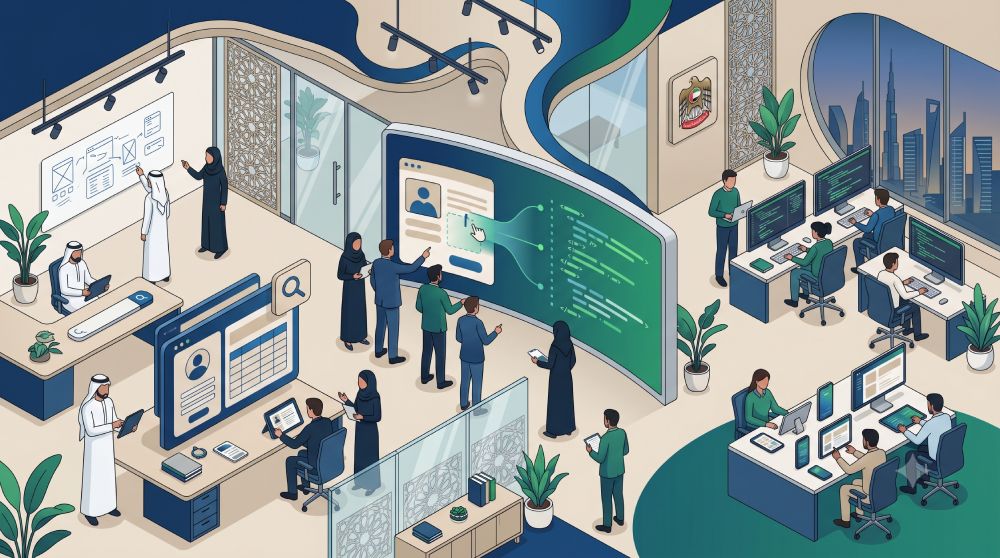
Not every federal entity has a twenty-person design team. Many have a designer and two developer. AI tools make the compliance bar of the AEGOV Design System — typography, colour tokens, accessibility, bilingual content — achievable for these teams, not aspirational. The design system becomes a force multiplier when it is grounded into the tools as context.
UAE Pass scaffolding becomes default
The most common authentication flow in UAE government services can now be scaffolded into a prototype from the first generation, rather than bolted on at the end. This matters because authentication is where many services fail their first usability test — the integration is solid in production but absent in the prototype, so people hit a friction point that was never tested.
Bilingual prototypes from day one
Generating English and Arabic versions side by side from the start changes how RTL issues are found. Instead of being discovered during QA, they are visible during the interview itself. The risk, addressed below, is that Arabic output quality is not yet equal to English. Discipline is required.
People enter the loop sooner
This is the deepest shift. In a traditional pipeline, the first real person test happens late — sometimes after months of internal work, or worse - does not happen at all. With AI-compressed iteration, the first test can happen in week one. The implication is not "we ship faster." The implication is "we test more, within the same timeline". (For why early people feedback matters more than late polishing, see our piece on The Empathy Engine.)
The risks worth naming
A balanced view requires saying clearly: these tools do not remove the work of building responsibly. They redistribute it. Six risks deserve explicit attention.
Accessibility shortcuts
AI-generated markup often looks correct and behaves correctly for a sighted user, but fails silently for assistive technologies. Missing ARIA attributes, weak focus order, and decorative <div> elements where semantic HTML belongs are all common failures. The fix is unglamorous: every generated interface gets audited against WCAG 2.2, including the four new 2.2 criteria, before any person sees it. Our deeper piece on the role of ARIA in enhancing web accessibility covers what this audit needs to catch.
RTL quality
Most of these tools are trained predominantly on English-language interfaces. Arabic typography, line height, justification, and right-to-left flow are weaker out of the box. A UI in Arabic that looks acceptable to a non-Arabic-reading designer can be subtly wrong to a native speaker. Hence, ensure that every RTL layout is reviewed and tested with native Arabic speaker.
Design system drift
Without explicit grounding in the AEGOV Design System, generated components drift toward generic defaults. Colours land near-right rather than right. Spacing follows a different scale. Components compose in ways the design system does not permit. The fix is to feed the tool with the design system, which includes tokens, components, content rules and more.
Performance and sustainability
3D backgrounds, scroll-linked animations, and generated video are cheap to create now, but they are not cheap to deliver in terms of performance. A tourist data plan can pay the bandwidth cost. The Sustainable by Design ethos and the mobile-data realities surfaced in Thumb-driven Democracy both push the same way: generative visuals should justify their bandwidth cost before they ship.
Vendor lock-in and IP provenance
Tools come and go. APIs can be deprecated. The AEGOV Design System must always be the source of truth, and must be adapted to its latest version. Anything built on top of a specific tool needs to be portable away from it. The licence terms of using illustrations, 3D scenes, copy etc. must be clear before they go on a public-facing government service.
Conclusion
The shift in AI design tools is not really about the tools. It is about the cadence they enable.
For decades, government digital services have been built with people at the end of the line. They may have been consulted at the beginning, then absent until launch. In even worse cases - missing all togeather for testing and validation.
The handoff between designers and developers, between design and code, between intention and interface, has carried most of the weight. It is where time went. It is where quality dropped.
When that handoff dissolves, something else becomes possible. People can be present throughout the process. The design system can be present from the first generation. The RTL version can be tested alongside the LTR version, not after it. A small federal entity team can ship work to the same standard as a large one.
None of this is automatic. The risks are real, and the discipline required is meaningful. But for a government committed to human-centred services, this is the most consequential shift in how digital services get made.
The UAE Design System remains the anchor. Tools may change but the standards do not.
Start by grounding your tools in the UAE Design System Guidelines, and explore the Sustainable by Design series for the broader principles that should shape your tool choices.